






















Is a larger capacity always better for C&I energy storage? Key factors to consider when selecting a system
-
Technical Blog
-
 2026-10-23
-
 Dyness

For Dyness commercial and industrial (C&I) energy storage systems, capacity should not be estimated simply based on a company’s total daily electricity consumption. Instead, the process should begin by determining the required power output (kW) for the project, followed by calculating the necessary energy capacity (kWh) based on factors such as peak/off-peak electricity pricing, surplus photovoltaic (PV) generation, or the required duration of backup power. The selection logic varies depending on the specific context—whether it involves peak-valley tariff structures in China, dynamic pricing in Europe, PV self-consumption optimization, or backup power requirements. The ultimate objective is to align the energy storage capacity with the actual, usable charge-discharge windows, rather than merely pursuing the largest possible battery capacity.
Core Logic for Capacity Sizing in C&I Energy Storage Systems
For many industrial and commercial energy storage projects, the initial design phase often begins with an analysis of the enterprise's monthly electricity bill. For instance, if a business consumes 1 MWh of electricity per month, one might simply estimate the daily energy storage requirement by dividing the monthly consumption by 30 days. The flaw in this approach is that energy storage is not intended to cover an enterprise's total electricity consumption throughout the entire day, rather, it is designed to shift electricity usage to specific time periods. Therefore, determining the appropriate system configuration requires answering two fundamental questions: First, what power capacity is needed—that is, how many kilowatts (kW) must the system be able to charge or discharge at any given moment? Second, how long must this power output be sustained? This duration determines the total energy capacity (in kWh) required. Consequently, the fundamental relationship is as follows:
Energy storage capacity ≈ effective charge and discharge power × effective duration
However, the definitions of "effective power" and "effective duration" vary significantly across different application scenarios.
For instance, in the case of projects involving fixed peak-valley electricity pricing in China, it is essential to determine how much of an enterprise’s load during high-price periods can actually be offset by energy storage. For projects in Europe utilizing dynamic electricity pricing, the focus should be on identifying the specific daily windows of low and high prices that offer genuine arbitrage potential. For solar-plus-storage projects, one must calculate the actual surplus photovoltaic (PV) energy available. As for backup power projects, the system configuration should be based on critical load requirements and the specified duration for which backup power must be provided.
Key Factors Influencing Capacity Selection for Dyness Commercial and Industrial Energy Storage Systems
Actual Load Profile of an Enterprise
When selecting an energy storage system, it is best to use at least one year of 15-minute interval load data, rather than relying solely on total monthly electricity consumption. For instance, if a facility’s peak load is 500 kW, it does not necessarily require a 500 kW energy storage system. If the facility’s load is only 200 kW for most of the time during high-tariff periods, then even with a 500 kW Power Conversion System (PCS) installed, there would be insufficient load to absorb the energy discharged from the storage system. Therefore, the power capacity of the PCS should be determined by the actual load during the targeted charge/discharge periods, rather than by the facility’s historical peak load.
local electricity price mechanism
In China, industrial and commercial energy storage systems currently most commonly operate under time-of-use electricity pricing structures that feature peak, flat, off-peak, and "super-peak" (or "extra-peak") periods.
Taking Shanghai’s summer time-of-use electricity pricing as an example:
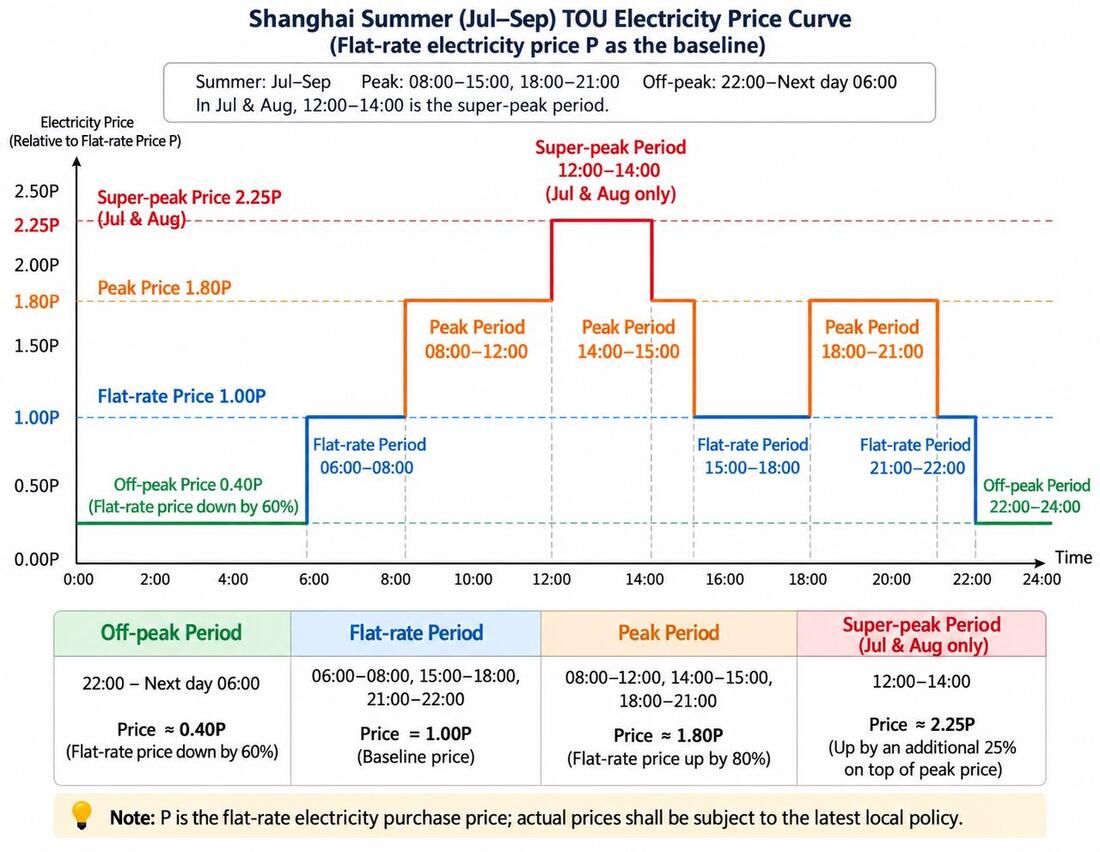
This chart illustrates the time-of-use (TOU) electricity pricing in Shanghai during the summer months (July–September). Using the standard on-grid electricity price ($P$) for Shanghai as a baseline, the chart clearly delineates various time periods and their corresponding electricity rates. Notably, the "peak" category is further subdivided: during July and August, the 12:00–14:00 window is classified as a "super-peak" period, with a rate 2.25 times the baseline price. Other intervals are categorized into peak, normal (mid-peak), and off-peak periods, each governed by specific pricing rules—for instance, the peak-period rate is 1.8 times the baseline, the off-peak rate is 60% lower than the baseline, and the normal period is billed at the baseline rate. This pricing schedule serves as a foundational reference for determining the capacity of industrial and commercial energy storage systems, enabling enterprises to identify high-cost time slots and align their energy storage discharge windows accordingly.
Therefore, the greatest value of energy storage typically does not lie in continuous discharge throughout the day, but rather in prioritizing coverage during peak and high-demand periods. If the most economically valuable discharge window each day is approximately two hours, then an energy storage configuration with a duration of around two hours should be prioritized. Only if high-price periods persist for more than four hours—and the enterprise maintains sufficient load throughout that entire duration—would increasing the storage duration potentially generate additional value.
Europe is different:
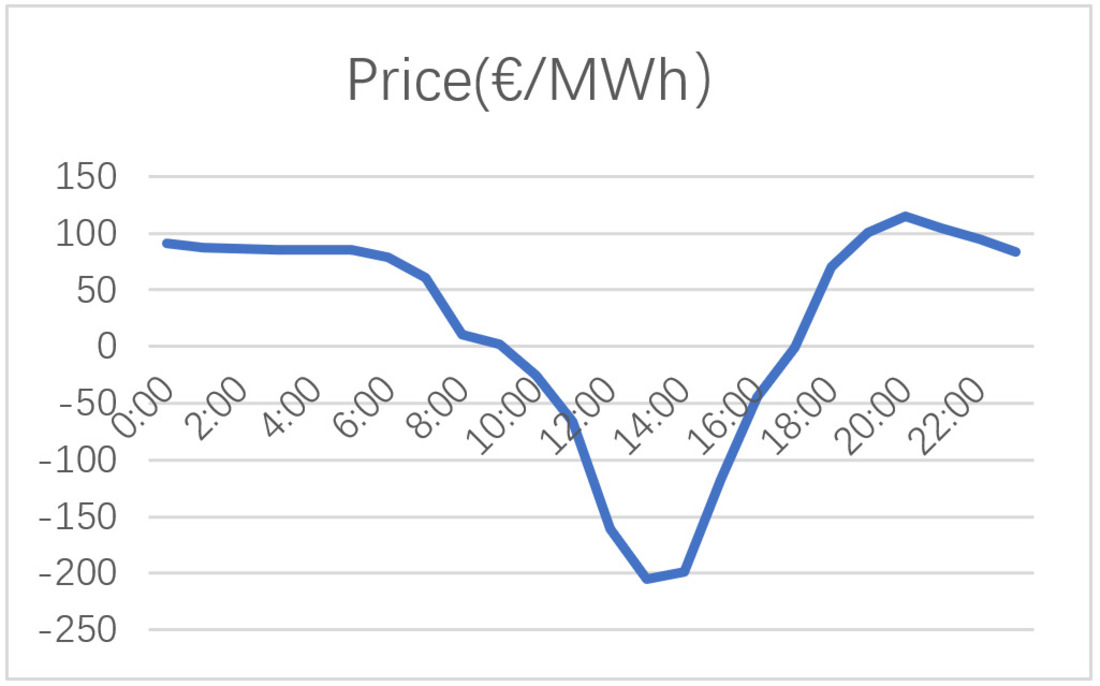
The image displays a dynamic electricity price curve, with the horizontal axis representing time (0:00–24:00) and the vertical axis representing price (€/MWh). It illustrates how dynamic electricity prices in Europe fluctuate throughout the day: prices reach a low of nearly -200 €/MWh between 12:00 and 14:00, while rising to approximately 100 €/MWh between 18:00 and 20:00. This chart provides a clear visualization of how dynamic electricity prices in Europe shift in response to day-ahead or intraday market conditions, serving as a useful reference for understanding a company’s actual load profile and determining appropriate energy storage capacity.
Dynamic electricity prices fluctuate based on day-ahead or intraday market conditions, meaning that the timing of high and low price periods can vary from day to day. Taking the German market as an example—where a significant number of hours with negative electricity prices are projected for 2025—it becomes clear that for projects in Europe, backtesting against historical price data is essential to identify truly valuable arbitrage windows.
Whether to include a photovoltaic (PV) system
The capacity of a photovoltaic (PV) project cannot be determined simply by a fixed ratio of "MWh of energy storage per MW of PV capacity." What actually needs to be calculated is:
Surplus PV power = PV power generation − real-time enterprise load
Only the portion greater than zero represents the surplus photovoltaic (PV) energy that can be absorbed by the energy storage system. The daily PV energy available for storage can be approximated as follows: Daily storable PV energy = Σ (PV power − enterprise load) × time.
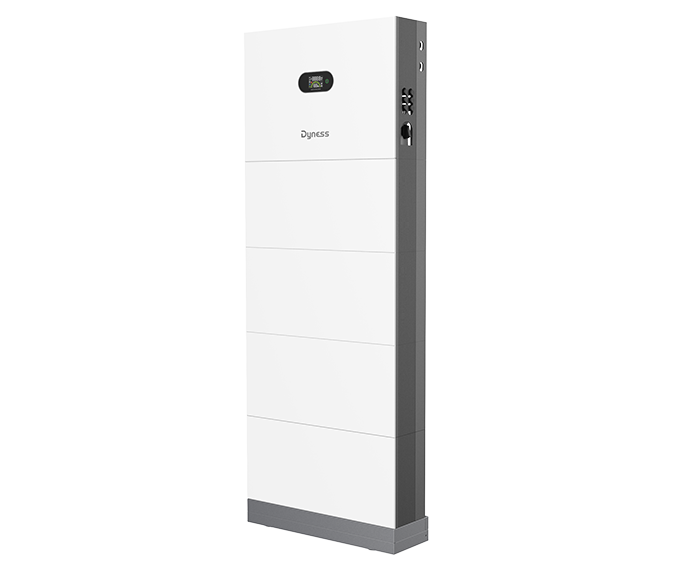
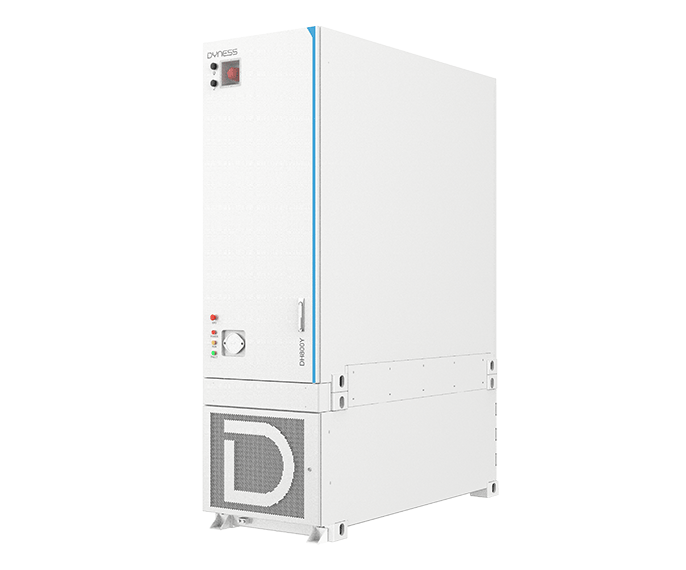
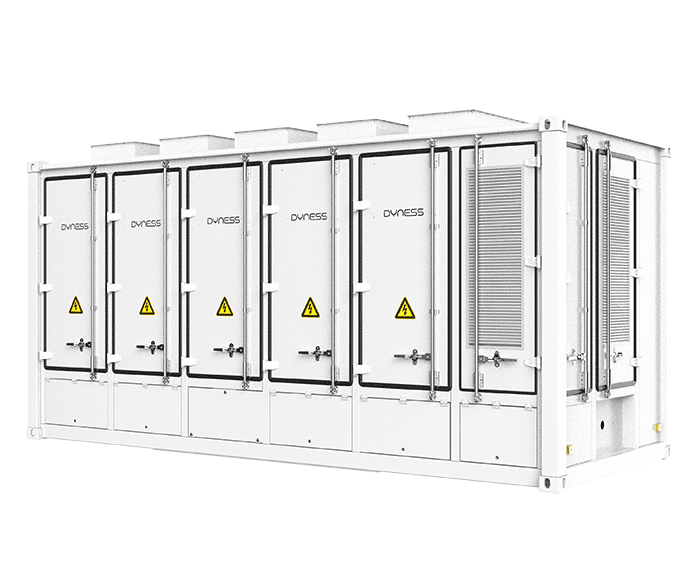
For instance, if a project has a typical daily surplus of only 230 kWh of solar energy, installing a 500 kWh or even 1 MWh energy storage system would likely mean the system cannot be fully charged each day using only that surplus. In such a scenario, the Dyness DH200Y-C260—with its 125 kW / 261 kWh capacity—is a much better fit for these requirements. Alternatively, if there is a need for direct solar integration, the DH200F-C260 offers 261 kWh of storage capacity while supporting up to 252 kW of PV input and featuring 4 MPPT channels.
Is the high-price window "short and tall" or "long and wide"?
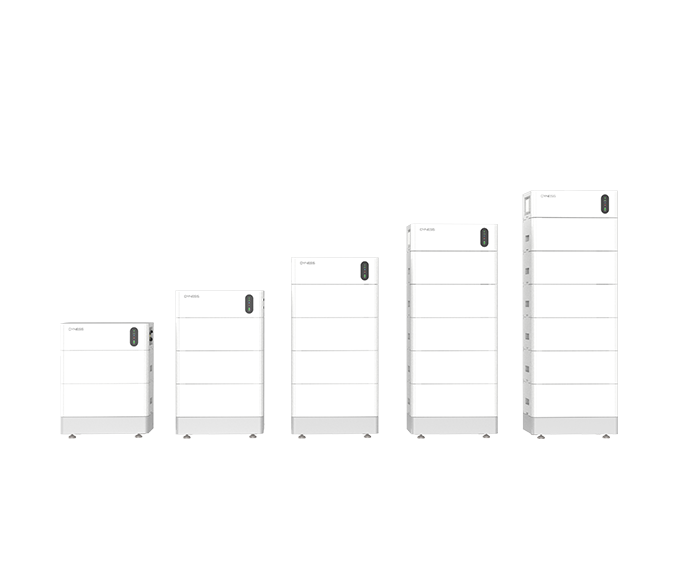
This is particularly important for large-scale C&I (commercial and industrial) projects. The Dyness DH800Y is available in two power configurations: 420kW/836kWh and 210kW/836kWh. If a project’s most lucrative high-tariff periods are concentrated within a short window of 1–2 hours—for instance, when electricity prices spike rapidly in the evening—the 420kW/836kWh configuration is better suited for high-power, short-duration arbitrage, as it can discharge a larger volume of previously stored, lower-cost energy over a shorter timeframe. Conversely, if high-tariff periods persist for 3–4 hours and the facility maintains a stable load throughout that entire duration, the 210kW/836kWh configuration—offering a longer discharge duration—may be a more appropriate fit.
Therefore, the distinction between 2H and 4H is not simply a matter of determining "which battery has more capacity", rather, it concerns the timeframe over which a given amount of energy needs to be discharged.
Is there a requirement for backup power?
If the primary objective of a project is to provide backup power during an outage, the first step should be to calculate the "critical load power × required duration," rather than basing the configuration on the enterprise's total load. For instance, if an enterprise has a large overall load but only specific systems—such as production control systems, servers, fire safety equipment, or core production lines—must remain operational during a power failure, the energy storage system should be designed to prioritize these critical loads. In this scenario, the power conversion system (PCS) determines the maximum load that can be supported simultaneously, while the battery capacity determines the duration for which that load can be sustained.
Will the next energy storage unit be fully utilized once it is added?
For small to medium-sized projects, a single Dyness DH200Y-C260 unit offers a capacity of 125 kW / 261 kWh, with support for parallel expansion. If backtesting results indicate an optimal discharge power of approximately 100–125 kW—aligned with a primary high-tariff window of about two hours—and an economically viable energy-shifting capacity of roughly 200–250 kWh per cycle, then a single DH200Y-C260 unit serves as a logical starting point.
If the actual amount of electricity that can be economically transferred by the project is increased to about 500kWh, then consider: 2 × DH200Y-C260 = 250kW / 522kWh. The key is not "can a second unit be added?", but: How many days a year can the added 261kWh of the second unit be charged and released at a valuable time?
When the utilization rate and marginal returns of additional energy storage units decline significantly, the expansion of capacity should be halted.
Taking into account load, electricity price windows, and shiftable energy, the DH200Y-C260 can serve as a foundational configuration for the following projects:
For a project in the several-hundred-kWh range—where the primary objective is peak-valley arbitrage, the main discharge window is approximately 2 hours, the power requirement is around 100–125 kW, the energy capacity per discharge cycle is roughly 200–250 kWh, and there is an intention to expand capacity later via parallel connection—the DH200Y-C260 (125 kW / 261 kWh) serves as a logical baseline configuration.
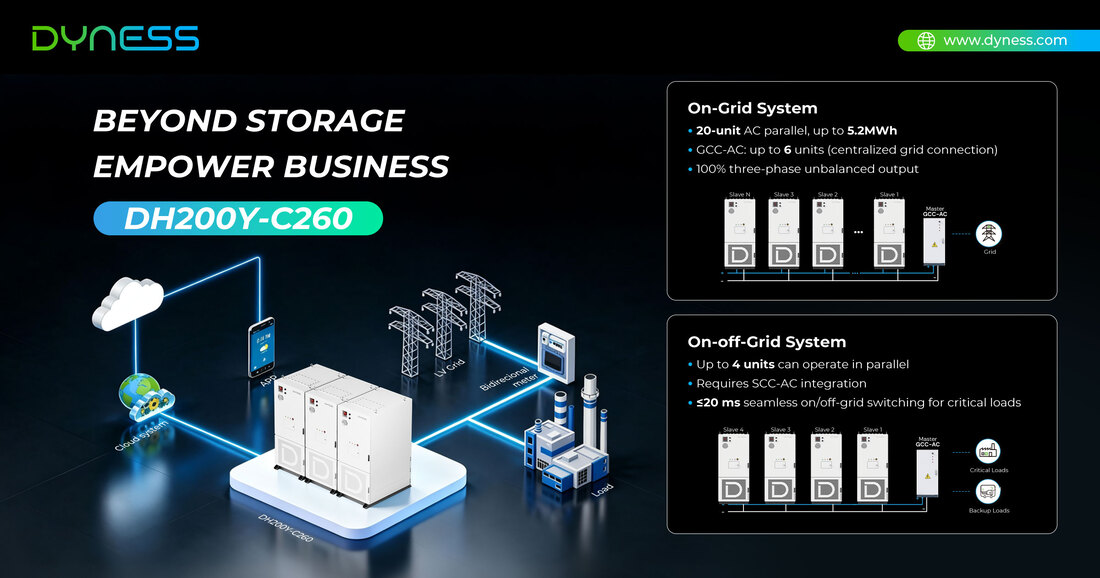
If the project also requires direct integration of photovoltaics (PV), an increase in the self-consumption of PV-generated power, or support for both on-grid and off-grid operation, then the DH200F-C260 may be considered.
If, in addition to energy storage, the project also requires direct integration of photovoltaics (PV) to increase the self-consumption of solar energy, or necessitates both on-grid and off-grid capabilities, then the DH200F-C260 model may be a suitable option to consider.
For large-scale factories, industrial parks, or MWh-scale projects, various power configurations of the DH800Y can be selected based on load requirements and electricity price windows:
For large-scale factories, industrial parks, or MWh-scale projects requiring higher charge/discharge power or longer durations, the DH800Y system offers different power configurations tailored to specific load requirements and electricity price windows: the 420kW / 836kWh configuration is better suited for high-power applications (with a duration of approximately 2 hours), while the 210kW / 836kWh configuration is geared toward longer-duration applications (approximately 4 hours).
However, in the following situations, it is not advisable to increase energy storage capacity based solely on experience:
Increasing capacity based solely on intuition is not recommended in the following scenarios: a lack of 15-minute interval load data, uncertainty regarding actual peak and off-peak electricity tariffs, very low enterprise load during high-tariff periods (meaning nearly all solar PV output can be consumed in real-time), an insufficient daily window for low-cost charging, or a situation where the additional capacity would remain idle for most of the time. In such cases, a thorough data analysis and a retrospective assessment of potential returns should be conducted before deciding whether to expand energy storage capacity.
Therefore, the core principles for selecting industrial and commercial energy storage systems can be summarized as follows: for peak shaving, consider "the power threshold (in kW) and the required duration", for peak-valley arbitrage, assess "how much energy can be shifted during high-price periods", for solar-plus-storage, determine "the actual surplus of solar generation each day", for backup power, evaluate "how long critical loads need to be supported", and for dynamic pricing markets (such as in Europe), look at "the width of the price windows that offer profit potential."
The process should begin by calculating the actual kW and kWh requirements of the project, followed by selecting the appropriate product—such as the DH200Y-C260, DH200F-C260, or DH800Y—rather than choosing an energy storage cabinet first and then forcing the project to adapt to the product.